

Author: Dr. Terry Acie
Keywords: Democratic Socialism, Constitutional Republic, Constitutional Governance, Public Administration, Parliamentary Sovereignty, Marxism
Introduction
The purpose of this Research and Commentary (R&C) article is to understand the impact democratic socialism has on a constitutional republic and its implications in public administration. Additionally, this R&C article at the surface level provides some comparisons between three contrasting countries: The United States, Venezuela, and the United Kingdom. The article provides definitions, key proponents, impact on middle-class Americans, and administrative lessons. This article serves as the precursor to an in-depth journal article currently being researched on the impact that democratic socialism, as proliferated by the Democratic Socialists of America (DSA) has on a constitutional republic as exhibited in the United States of America. The differences between democratic socialism and a constitutional republic, and the potentially detrimental effects of democratic socialist policies on constitutional governance, are complex and multifaceted. These effects are rooted in the competing philosophical and ideological foundations of each system, as well as the fundamentally different end-state objectives their proponents pursue through governance, legislation, and public administration.
Research Question: How do democratic socialist policies influence the constitutional institutions that safeguard a constitutional republic?
Definitions from Scholarship
A constitutional republic is a representative political order in which public authority is organized and limited by a constitution (Michaels, 2018; Rosenfeld, 1994). Its defining features include legally structured institutions, separated governmental powers, representative decision-making, and enforceable limits on officials. The central administrative principle is that public agencies may act only through lawful authority and remain accountable to legislatures, courts, and constitutional rights (Rosenfeld, 1994).
A democratic socialist system combines democratic political institutions with substantial collective ownership or control of productive assets and a more egalitarian distribution of wealth (Accetti, 2025). Contemporary scholarship distinguishes democratic socialism from ordinary social-democratic policy: the former generally seeks to democratize ownership and economic decision-making, while the latter usually retains private ownership alongside regulation, taxation, and a large welfare state (McIntyre, 2023).
These terms are not exact opposites. A constitutional republic describes the structure and legal limits of government, whereas democratic socialism describes a political-economic program that may be pursued within a constitutional system. The important public-administration question is how far elected governments may expand public ownership, redistribution, and administrative authority without weakening constitutional restraints.
The American Constitutional Model
The United States was established through the Constitution drafted by delegates to the Philadelphia Convention in 1787 (Banks, 1966). The founding design created a federal republic with separated powers, representative institutions, enumerated authority, and checks intended to prevent the concentration of power (Boskin & Rice, 2024). The separation in this system is known as federalism, which divides power between executive, legislative, and judicial branches of government (Boskin & Rice, 2024). The idea that no concentration of power or authority can accumulate into one branch more than another in a redundant network of checks and balances provides safeguards for the nation.
The principal constitutional founders included George Washington, James Madison, Alexander Hamilton, Benjamin Franklin, John Adams, Thomas Jefferson, and other revolutionary-era leaders, although not all participated equally in drafting or ratifying the Constitution (Kämmen, 2018). Understanding the constitutional founders’ governing philosophies is essential because they established the institutional framework that continues to shape American public administration. The Constitution was intentionally designed to limit the arbitrary exercise of governmental power through the rule of law and institutional constraints intended to preserve individual liberty (Rogg, 2019). James Madison’s concern over factions sought to prevent concentrated political power from dominating government; Alexander Hamilton advocated for an energetic yet constitutionally constrained executive capable of administering national affairs, and George Washington emphasized civic virtue, political restraint, and institutional legitimacy. Together, these principles created a constitutional system intended to preserve liberty while promoting stable governance.
In this model, administrators are not independent rulers. They are agents of constitutionally authorized officials and must operate through:
➡️ Statutes enacted by Congress or state legislatures.
➡️ Appropriations and budgetary controls.
➡️ Administrative procedures and transparency requirements.
➡️ Judicial review.
➡️ Federalism, which divides authority among national, state, and local governments.
➡️ Rights protections that restrict even popular majorities.
This does not mean the United States has a minimal state, that is, a government that performs only its most basic functions. American governments operate schools, public-health programs, transportation systems, courts, police departments, regulatory agencies, and social-insurance programs. These are large and complex organizations that provide essential services to the citizenry. The constitutional-republic framework determines how those programs are authorized and reviewed; it does not automatically determine whether government should provide more or fewer services.
Marx and Democratic Socialism
Karl Marx supplied the most influential theoretical critique of capitalism associated with socialism (Bergh et al., 2025; Carnevali & Ystehede, 2023). In works including The Communist Manifesto and Das Kapital, Marx analyzed society through class relations, arguing that owners of capital control productive resources while workers sell their labor. His analysis treated economic organization as a source of political power, not merely as a private matter.
Later democratic socialists adapted Marx’s critique while rejecting one-party dictatorship and revolutionary violence. Contemporary democratic-socialist proposals commonly emphasize public ownership, worker control, economic democracy, and redistribution, but they vary considerably in how much they rely on markets and private enterprise (Carnevali & Ystehede, 2023).
For public administration, Marx’s influence appears in several policy priorities:
➡️ Reducing disparities in wealth and bargaining power.
➡️ Expanding public control over healthcare, education, energy, transportation, or finance.
➡️ Giving workers a formal role in organizational governance.
➡️ Treating economic security as a public responsibility.
➡️ Measuring administrative success through equality as well as efficiency.
These goals differ from the constitutional-republic tradition primarily in emphasis. Constitutional republicanism is grounded in the rule of law (Rosenbloom, 2019), the protection of individual rights (Henkin, 1994), representative government, separation of powers, and institutional restraints designed to prevent the arbitrary concentration of political authority (Rosenfeld, 1994). Democratic socialism begins with economic power, material equality (Bergh et al., 2025), and collective control of productive resources (Maguire, 2026). These philosophical distinctions provide the foundation for understanding how democratic socialism evolved within the American political context. No individual was more influential in articulating this vision in the United States than Michael Harrington (McIntyre, 2023). Rather than advocating revolutionary Marxism, Harrington argued that democratic institutions could serve as the vehicle for achieving socialist objectives through electoral politics (Dorrien, 2021), expanded social welfare programs, and the gradual democratization of economic institutions (Carnevali & Ystehede, 2023).
Harrington and The Other America
Michael Harrington was an American socialist writer and political activist whose 1962 book The Other America brought national attention to persistent poverty in the United States (Dorrien, 2021). Harrington challenged the assumption that postwar prosperity had eliminated deprivation and argued that millions of Americans remained outside the benefits of economic growth (Accetti, 2025; Dorrien, 2021).
Harrington’s work is important to understand because it links social research to public administration, which has become a primary driver and influence of the current wave of people promoting the Democratic Socialists of America’s (DSA) agenda. Poverty, in Harrington’s understanding, was not simply an individual failure; it was also an institutional problem requiring public programs, targeted services, and political attention. His analysis helped influence many political actors in the United States, such as Lyndon B. Johnson, to wage a war on poverty and encouraged administrators to examine whether apparently successful national policies reached marginalized communities (Dorrien, 2021). More recently, political actors such as New York City Mayor Zohran Mamdani, Vermont Senator Bernie Sanders, and New York Representative Alexandria Ocasio-Cortez have proliferated the DSA agenda into mainstream conversation in the United States (Mitrulevicius, 2025).
Harrington did not establish that every form of democratic socialism must abolish private property or constitutional government (Dorrien, 2021). Rather, his work illustrates a democratic-socialist argument that formal political rights are insufficient if citizens lack meaningful access to food, housing, healthcare, education, and employment.
Comparative Analysis of the United States, Venezuela, and the United Kingdom
Understanding the relationship between democratic socialism and constitutional governance requires more than a theoretical comparison of political ideologies. It also requires examining how democratic socialist principles have interacted with existing constitutional structures in practice. The experiences of the United States, Venezuela, and the United Kingdom illustrate three distinct approaches to balancing democratic governance, administrative authority, social welfare, and constitutional constraints. Each case reflects a different constitutional framework, institutional design, and degree of state involvement in economic and social policy, making them valuable comparative examples within public administration scholarship. Comparative public administration provides a useful framework for evaluating how constitutional institutions shape administrative outcomes across different political systems and how varying constitutional arrangements influence the implementation of public policy.
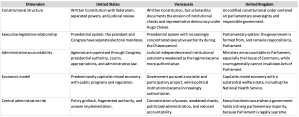
These cases should not be interpreted as representing identical forms of democratic socialism or constitutional governance. Rather, they demonstrate how similar policy objectives may produce different institutional outcomes depending on the strength of constitutional safeguards, the distribution of political authority, and the independence of administrative institutions. The United States illustrates a constitutional republic that has incorporated extensive social welfare policies while preserving constitutional limitations on governmental power. Venezuela demonstrates the risks associated with weakening institutional checks and concentrating executive authority under the banner of democratic legitimacy. The United Kingdom offers a parliamentary constitutional system that combines an expansive welfare state with a predominantly market-based economy, illustrating that extensive public provision alone does not necessarily constitute democratic socialism. Together, these cases provide a comparative foundation for evaluating whether democratic socialist policies operate within, adapt, or fundamentally reshape constitutional governance and public administration.
Table 1 presents a comparative overview of the United States, Venezuela, and the United Kingdom across key dimensions of constitutional governance, democratic socialism, and public administration. Rather than evaluating individual policies in isolation, the table highlights how differences in constitutional design, institutional constraints, and administrative structures shape the implementation of social and economic reforms. This comparison provides a concise framework for examining how democratic socialist policies interact with varying constitutional systems and serves as a foundation for the subsequent case analyses. By comparing these three countries, the analysis identifies institutional characteristics that either preserve constitutional accountability or facilitate the concentration of governmental authority, thereby addressing the study’s research question regarding the influence of democratic socialist policies on constitutional governance and public administration.
Table 1.
United States, Venezuela, and the United Kingdom Governance Comparison Table
The United States
The United States demonstrates that a constitutional republic can adopt substantial redistributive and social-welfare policies without becoming a socialist system, but the increase in the number of elected political agents like Zohran Mamdani and Bernie Sanders within public administration seeks to degrade the safeguards federalism places in the constitutional republic through the centralizing of government authority in executive ranks. Public administration remains divided among federal, state, and local governments, and programs must be justified through constitutional and statutory authority. However, the repeated weakening of constitutional and statutory authority will eventually yield to the proliferation of democratic socialist principles that undermine governance as currently enacted.
From the perspective of the Democratic Socialists of America, the American constitutional structure can create significant obstacles to implementing broad policy reforms. Separation of powers may slow legislative action, federalism can produce uneven policy implementation across states, and judicial review may constrain administrative initiatives. Democratic socialists often regard these institutional constraints as limiting the capacity of democratic majorities to enact structural economic and social reforms, particularly those involving expanded public ownership, redistribution, or economic democracy (Accetti, 2025; Bolton, 2020). In contrast, proponents of constitutional republicanism view these same constitutional safeguards as essential mechanisms for preserving the rule of law, preventing the concentration of governmental authority, and protecting individual liberty against temporary political majorities (Rogg, 2019).
Venezuela
Venezuela illustrates how democratic backsliding can occur despite the continued existence of elections and democratic rhetoric. Corrales (2023) argues that the Chávez administration systematically eroded liberal democratic institutions by expanding executive authority, capturing key governance institutions, and weakening constitutional checks and balances. Rather than representing an abrupt transition to authoritarianism, Venezuela experienced a gradual process of institutional transformation in which democratic procedures formally persisted while the independence of the judiciary, legislature, and other accountability mechanisms progressively declined.
From a general perspective, not every socialist policy causes authoritarianism. Democratic socialism, by definition, claims to preserve democratic control. The Venezuelan case instead demonstrates the danger that can arise when a governing movement uses popular legitimacy to subordinate courts, legislatures, electoral competition, civil society, and administrative independence to a centralized executive.
From a public administration perspective, Venezuela expresses how the erosion of constitutional constraints can transform administrative institutions from politically neutral implementers of public policy into instruments of executive control. As institutional capture expanded under Chavismo, the autonomy of governance institutions declined, reducing the capacity of public administration to operate independently of partisan political objectives (Corrales, 2023).
Table 2.
Corrales’ Institutional Pathway from Democracy to Authoritarianism in Venezuela

Table 2 summarizes Corrales’ (2023) conceptual progression of democratic backsliding in Venezuela, illustrating how constitutional governance can gradually transition from representative democracy to authoritarian rule. Rather than depicting an abrupt collapse of democratic institutions, the framework demonstrates how executive authority may progressively weaken constitutional checks and balances through institutional capture, consolidation of political power, and the erosion of administrative independence. This progression highlights the importance of maintaining robust constitutional safeguards, independent public institutions, and the rule of law to preserve democratic accountability. While developed from the Venezuelan experience, the framework provides a useful comparative lens for examining how the concentration of governmental authority may influence constitutional governance and public administration in other democratic systems.
The United Kingdom
The United Kingdom provides a useful contrast to the United States because it operates under the doctrine of parliamentary sovereignty rather than a constitutional republic with a codified constitution. Parliament retains supreme legislative authority, yet that authority is exercised within an evolving constitutional framework shaped by devolution, constitutional conventions, political accountability, and judicial norms. Elliott (2002) argues that constitutional reforms, particularly devolution and human rights legislation, have significantly altered the political and constitutional environment in which Parliament exercises its legislative powers. Similarly, Trench (2012) demonstrates that devolution has redistributed governmental authority across the United Kingdom while encouraging many constitutional disputes to be resolved through political processes rather than judicial intervention. Consequently, although Parliament remains legally sovereign, its exercise of power increasingly reflects constitutional evolution through political practice rather than formal constitutional amendment.
The evolution of the British state also demonstrates why an expansive welfare system should not automatically be equated with democratic socialism. Although Parliament has authorized significant public programs—including the National Health Service—the United Kingdom continues to operate primarily as a market-based economy in which private ownership and market competition remain the dominant mechanisms of economic organization (Bolton, 2020; Mitrulevičius, 2025). Nevertheless, the British experience illustrates how democratic socialist ideas can gradually expand the scope of parliamentary governance without replacing the existing constitutional order. Rather than fundamentally restructuring constitutional institutions, democratic socialist and social democratic policies have generally increased Parliament’s role in the provision of public services, economic regulation, and social welfare. This incremental expansion of governmental responsibility demonstrates how the boundaries of parliamentary administration can broaden over time while preserving parliamentary sovereignty and representative democratic institutions.
Public Administration and the Middle Class
The United States demonstrates that a constitutional republic can adopt redistributive and social welfare policies while preserving a predominantly market-based economy. Constitutional constraints—including the separation of powers, federalism, and judicial review—require that significant expansions of government be authorized through legislative and constitutional processes, thereby slowing the pace of institutional change. These structural safeguards distribute authority among competing institutions and provide taxpayers with multiple avenues of political accountability before additional public expenditures are authorized.
From a fiscal perspective, however, expanding governmental responsibilities carries long-term economic implications. Bergh et al. (2025) argue that when state intervention expands beyond economically sustainable levels, growth may slow as public resources are increasingly diverted from productive private investment toward government consumption and redistribution. As public expenditures continue to increase, governments must finance those commitments through higher taxation, increased borrowing, or deficit financing. In mixed-market economies such as the United States, these fiscal obligations frequently affect middle-income households, which comprise the largest segment of the tax base. Consequently, the principal concern is not the existence of social welfare programs, but whether the continued expansion of governmental responsibilities remains fiscally sustainable while preserving economic growth and constitutional accountability (Bergh et al., 2025).
Venezuela illustrates how expanding the role of the state without corresponding institutional constraints can generate both constitutional and economic deterioration. Corrales (2023) argues that the Chávez administration progressively weakened constitutional checks and balances by concentrating authority within the executive branch, reducing the independence of institutions responsible for political accountability. As executive authority expanded, public administration increasingly became an instrument of political control rather than an independent mechanism for implementing public policy.
The fiscal consequences of this expansion compounded the constitutional transformation. Venezuela financed an increasingly interventionist state through petroleum revenues while simultaneously expanding subsidies, public employment, and state ownership. When energy revenues declined, the government lacked a sustainable economic base to finance its commitments, contributing to inflation, currency instability, and declining private investment. Bergh et al. (2025) contend that persistent expansion of state intervention can weaken long-term economic performance when productive markets are displaced by politically directed allocation of resources. Although Venezuela’s fiscal crisis ultimately affected all socioeconomic groups, the middle class experienced significant erosion of purchasing power through inflation, currency depreciation, declining real wages, and capital flight. Rather than preserving economic security, the combination of institutional centralization and fiscally unsustainable state expansion substantially reduced the economic resilience of middle-income households (Bergh et al., 2025).
The comparison between the United States, the United Kingdom, and Venezuela suggests that the principal issue is not whether governments provide public services, but whether the expansion of governmental responsibilities remains constitutionally constrained and fiscally sustainable. The United States demonstrates how constitutional institutions can moderate the pace of governmental expansion through separation of powers and federalism. The United Kingdom illustrates how parliamentary sovereignty has accommodated an expanded welfare state while continuing to operate within a market-based economy and an evolving constitutional framework. Venezuela, by contrast, demonstrates how weak institutional constraints combined with expansive state intervention can undermine both constitutional governance and long-term economic stability. Together, these cases suggest that poorly constrained expansion of the state may impose increasing fiscal obligations on taxpayers—particularly the middle class—while simultaneously reducing the economic growth necessary to sustain those commitments over time (Bergh et al., 2025).
Conclusion
The answer to the research question is very complex and nuanced. The comparative experiences of the United States, the United Kingdom, and Venezuela demonstrate that democratic socialism should not be evaluated solely by its stated objectives of promoting economic equality and expanding social welfare. Rather, its implications must also be assessed in terms of how its underlying philosophical commitments interact with constitutional governance and public administration. Contemporary democratic socialism, while rejecting revolutionary communism, remains rooted in a Marxist critique of capitalism that seeks to redistribute economic power through a substantially expanded role for the state in directing economic and social policy (Bolton, 2020; Mitrulevičius, 2025; Accetti, 2025).
The United States has thus far demonstrated that a constitutional republic can incorporate extensive social welfare programs while preserving the institutional safeguards of separation of powers, federalism, and judicial review. These constitutional mechanisms do not merely slow policymaking; they serve as deliberate constraints designed to prevent the concentration of governmental authority and preserve the rule of law (Rogg, 2019). By contrast, Venezuela illustrates how the gradual weakening of institutional checks and balances, combined with the expansion of executive authority and state control over economic institutions, can contribute to democratic backsliding and diminished administrative independence (Corrales, 2023). The United Kingdom occupies an intermediate position, demonstrating that an expansive welfare state can coexist with democratic institutions and a market economy, while also illustrating how the incremental expansion of governmental responsibilities continually reshapes the practical exercise of parliamentary authority (Elliott, 2002; Trench, 2012).
For the United States, the principal question is not whether democratic socialist policies are inherently incompatible with constitutional republicanism, but whether the cumulative expansion of governmental authority remains consistent with the constitutional principles that define the American system of governance. As the scope of government expands, public administrators assume broader responsibilities that require increased fiscal resources, administrative capacity, and regulatory authority. Bergh et al. (2025) caution that sustained state expansion without corresponding economic productivity may reduce long-term economic growth, creating fiscal pressures that governments ultimately finance through taxation, borrowing, or inflation. Consequently, the long-term challenge for constitutional governance is ensuring that administrative growth remains constitutionally accountable, fiscally sustainable, and responsive to democratic oversight.
Ultimately, the strength of the American constitutional republic has never rested on the popularity of particular political ideologies but on the resilience of its constitutional institutions. Democratic socialism challenges policymakers and public administrators to balance demands for greater economic equality with the enduring constitutional principles of limited government, separated powers, representative democracy, and the rule of law. Preserving that balance will determine whether future reforms reinforce the constitutional framework established by the Founders or gradually alter the institutional character of American governance.
Question for future research: To what extent would a sustained increase in Democratic Socialists of America (DSA)-affiliated representation in Congress influence the constitutional balance among the legislative, executive, and judicial branches of the United States government?
REFERENCES
Accetti, C. (2025). What is democratic socialism in America? Left ideology in the age of populism. Journal of Political Ideologies, 30(2), 623–642. https://doi.org/10.1080/13569317.2023.2196243
Banks, M. A. (1966). Drafting the American Constitution- Attitudes in the Philadelphia Convention Towards the British System of Government. The American Journal of Legal History, 10(1), 15. https://doi.org/10.2307/844374
Bergh, A., Bjørnskov, C., & Kouba, L. (2025). The growth consequences of socialism. Journal of Comparative Economics, 53(2), 609–626. https://doi.org/10.1016/j.jce.2025.04.003
Boskin, M. J., & Rice, C. (2024). American Federalism Today: Perspectives on Political and Economic Governance. Hoover Institution Press. http://ebookcentral.proquest.com/lib/liberty/detail.action?docID=31528773
Carnevali, E., & Ystehede, A. P. (2023). Is socialism back? A review of contemporary economic literature. Journal of Economic Surveys, 37(2), 239–270. (163180648). https://doi.org/10.1111/joes.12488
Corrales, J. (2023). Autocracy Rising: How Venezuela Transitioned to Authoritarianism. Brookings Institution Press. https://www.jstor.org/stable/10.7864/j.ctvktrwq3
Dorrien, G. (2021). New Left, Old Left, and Michael Harrington. In American Democratic Socialism (pp. 362–459). Yale University Press. https://doi.org/10.2307/j.ctv1vbd123.10
Elliott, M. (2002). Parliamentary sovereignty and the new constitutional order: Legislative freedom, political reality and convention. Legal Studies, 22(3), 340–376. https://doi.org/10.1111/j.1748-121X.2002.tb00197.x
Henkin, L. (1994). A New Birth of Constitutionalism: Genetic Influences and Genetic Defects. In M. Rosenfeld (Ed.), Constitutionalism, Identity, Difference, and Legitimacy (pp. 39–54). Duke University Press. https://doi.org/10.2307/j.ctv1220mj4.5
Kämmen, M. (2018). “A Vehicle of Life”: The Founders’ Intentions and American Perceptions of Their Living Constitution. In A. P. Society (Ed.), A More Perfect Union (pp. 115–130). The American Philosophical Society Press. https://doi.org/10.70249/9798893983456-014
Maguire, B. (2026). Rescuing Socialism from Equality. Mind, 135(538), 403–432. https://doi.org/10.1093/mind/fzaf078
McIntyre, R. (2023). Democratic Socialism. Rethinking Marxism, 35(1), 24–35. https://doi.org/10.1080/08935696.2022.2127726
Michaels, J. D. (2018). THE SAFEGUARDS OF OUR CONSTITUTIONAL REPUBLIC: AN INTRODUCTION. UCLA Law Review, 65(6), 1391–1396. (132911051).
Mitrulevicius, G. (2025). Democratic Socialism and Social Democracy: The Relationship of Concepts in the Historical Aspect. Australian Journal of Politics and History, 71(4), 649–668. https://doi.org/10.1111/ajph.13061
Rosenbloom, D. H. (2019). Public administration and the erosion of the rule of law in the United States. Journal of Chinese Governance, 4(1), 1–14. https://doi.org/10.1080/23812346.2018.1564490
Rosenfeld, M. (1994). Modern Constitutionalism as Interplay Between Identity and Diversity. In M. Rosenfeld (Ed.), Constitutionalism, Identity, Difference, and Legitimacy (pp. 3–36). Duke University Press. https://doi.org/10.2307/j.ctv1220mj4.4
Trench, A. (2012). The Courts and Devolution in the UK. The British Journal of Politics and International Relations, 14(2), 303–322. https://doi.org/10.1111/j.1467-856X.2011.00497.x